Regenerative skin treatments are having a moment, and two names come up more than any others: exosomes and PRP. Both promise to rejuvenate your skin by tapping into your body’s own healing signals. Both are used for smoother texture, better tone, and a more youthful glow. So what is the difference, and which one is actually better?
The honest answer is more nuanced than the marketing suggests. This guide breaks down exosomes vs PRP: how each works, how they compare on results, evidence, convenience, and cost, and how to figure out which fits your goals. This is a straight-talking overview from the team at Zorah Med Spa in Des Plaines.
The Quick Answer
Neither treatment is universally “better.” They work differently and suit different situations:
- PRP uses your own blood, is well established with a long track record, and is a natural, proven choice.
- Exosomes are lab-derived, deliver a highly concentrated dose of cellular signals, and require no blood draw, but the treatment is newer with a less mature evidence base.
Many providers actually use them together. Let us look at why.
What Is PRP?
PRP stands for platelet-rich plasma, and it has been used across medicine for decades, from orthopedics to wound healing to aesthetics.
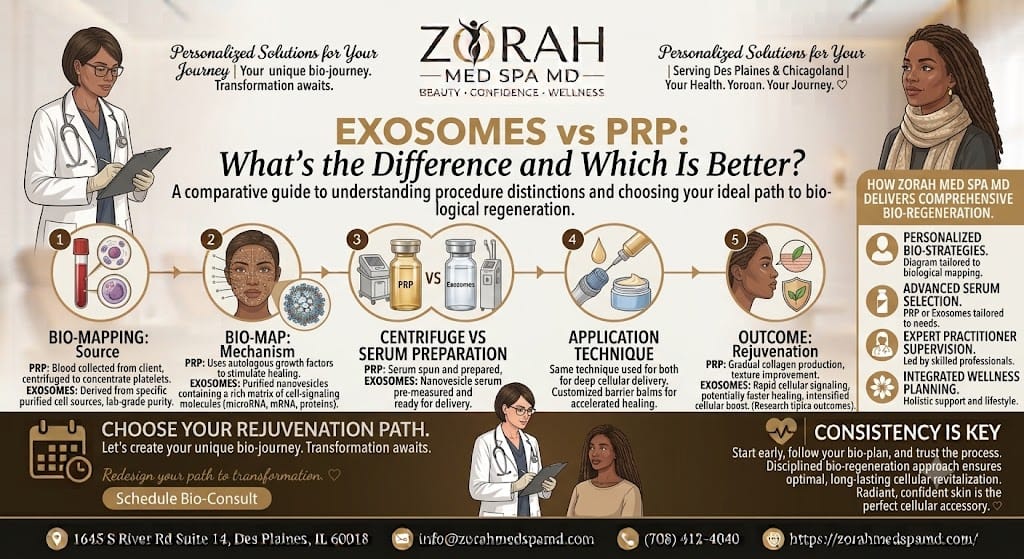
The concept is elegant: your own blood contains platelets packed with growth factors that drive tissue repair. For a PRP treatment, a provider draws a small amount of your blood, spins it in a centrifuge to concentrate those platelets, and then applies or injects the resulting plasma back into your skin. There, the growth factors stimulate collagen production and natural rejuvenation.
Because it comes from your own body, PRP is autologous, which means the risk of an allergic or immune reaction is very low. It is often paired with microneedling or injected to address volume and texture. You may also hear about PRF (platelet-rich fibrin), a newer evolution of PRP that forms a fibrin matrix and releases growth factors more gradually.
What Is Exosome Therapy?
Exosomes are tiny vesicles, essentially microscopic messengers, that cells use to communicate. They carry growth factors, proteins, and genetic instructions that tell other cells how to repair and regenerate.
Unlike PRP, exosome therapy is cell-free and is not made from your blood. Instead, the exosomes are lab-derived, typically sourced from stem cells or plant sources, and delivered as a concentrated serum, often applied after microneedling or a laser treatment so they can penetrate the skin.
The appeal is potency and consistency: a lab-standardized exosome product delivers a concentrated, uniform dose of signaling molecules every time, without depending on the quality of your own blood. The important caveat is that exosome therapy is considerably newer to aesthetics. Its evidence base, while growing, is less mature than PRP’s, and exosome products are not FDA-approved for aesthetic use. A responsible provider will be upfront about this.
Exosomes vs PRP: Key Differences at a Glance
| Factor | PRP | Exosomes |
|---|---|---|
| Source | Your own blood (autologous) | Lab-derived (stem cell or plant) |
| Blood draw | Required | Not required |
| Track record | Long, well established | Newer, less mature evidence |
| Consistency | Varies by your own biology | Standardized, concentrated dose |
| Regulatory status | Autologous, widely used | Not FDA-approved for aesthetics |
| Common delivery | Injection or with microneedling | Serum, often with microneedling |
Head to Head: The Key Differences
Where They Come From
This is the fundamental difference. PRP is 100 percent you, drawn and concentrated from your own blood. Exosomes are produced in a lab and are not derived from your body. Some people strongly prefer the natural, autologous nature of PRP, while others are drawn to the concentrated, standardized nature of exosomes.
Consistency and Potency
PRP’s strength depends on your own blood, which varies from person to person and can decline with age. Exosome products are standardized, so they deliver a consistent, concentrated dose of signaling molecules regardless of your individual biology. This consistency is one of exosomes’ main selling points.
Evidence and Track Record
Here honesty matters. PRP has been studied and used for decades, giving it a substantial track record. Exosome therapy is newer to aesthetics, and while early results and mechanisms are promising, the evidence base is less mature, and the products are not FDA-approved for cosmetic use. If a proven track record is important to you, that favors PRP. If you are comfortable with a newer, cutting-edge option, exosomes may appeal.
Convenience
Exosomes have an edge for the needle-averse: no blood draw is required, and treatment can be quicker since there is no blood processing step. PRP requires a simple blood draw, similar to routine lab work.
Cost
Exosome treatments are often more expensive per session than PRP, partly because the product is a manufactured, standardized biologic rather than something derived from your own blood. Your exact cost depends on your treatment plan.
What Each One Treats
Both exosomes and PRP are used for similar skin goals, which is part of why the exosomes vs PRP question comes up so often. Both are commonly used to improve overall skin quality, support a brighter and more even tone, soften fine lines, and boost collagen for firmer-looking skin. Both also pair well with microneedling, and both are used in hair restoration as well as facial rejuvenation.
The overlap in what they treat is exactly why the decision comes down to the finer differences, source, evidence, consistency, convenience, and cost, rather than one treating something the other cannot. For most skin-quality goals, either can be a reasonable starting point, and the right pick depends on your priorities.
So, Which Is Better?
By now the answer should be clear: it depends on your priorities.
PRP may be your choice if you value a proven, decades-long track record, prefer a natural treatment using your own body, and are comfortable with a quick blood draw.
Exosomes may appeal if you want a highly concentrated, consistent dose of regenerative signals, prefer to skip the blood draw, and are comfortable with a newer treatment.
There is no single winner, only the option that best fits your goals, comfort level, and how you weigh a proven track record against cutting-edge potency. That is a conversation to have with a qualified provider who can be honest about both.
Setting Realistic Expectations
Whichever you choose, it helps to approach regenerative treatments with the right mindset. These are not instant fillers or a one-visit transformation. Because they work by stimulating your skin’s own repair processes, results build gradually over weeks as new collagen develops, and a series of sessions is often recommended for the best outcome.
That gradual, natural improvement is exactly the appeal for many people, but it does require patience. Anyone promising dramatic overnight change from a single regenerative session is overselling. A good provider will give you an honest timeline for your specific goals.
Can You Combine Exosomes and PRP?
Yes, and many patients do. The two are not mutually exclusive. Some providers pair them, or pair either one with microneedling or laser treatments, to enhance results, using PRP’s natural growth factors alongside the concentrated signaling of exosomes.
In fact, microneedling with exosomes is a popular combination, using the micro-channels from microneedling to help the exosome serum penetrate more effectively. A personalized plan often blends treatments rather than relying on just one.
Find the Right Regenerative Treatment in Des Plaines
Both exosomes and PRP are exciting regenerative options, and the best choice depends on your skin, your goals, and your comfort level, ideally guided by an honest, physician-led evaluation.
At Zorah Med Spa, we offer both exosome therapy and PRP/PRF treatments, so our recommendation is based on what is genuinely best for you, not on what we happen to offer. During your consultation, we explain your options clearly, including the evidence behind each, and help you choose the right path.
Ready to explore regenerative skin treatment? Schedule a consultation online or call us at (708) 412-4040. We proudly serve Des Plaines, Park Ridge, Niles, and the surrounding suburbs.
Frequently Asked Questions
Is exosome therapy better than PRP?
Neither is universally better. PRP is proven, natural, and uses your own blood, while exosomes offer a concentrated, standardized dose of signals without a blood draw but are newer and not FDA-approved for aesthetics. The right choice depends on your goals.
What is the main difference between exosomes and PRP?
PRP comes from your own blood and is autologous, while exosomes are lab-derived and cell-free. PRP has a longer track record, while exosomes offer more concentrated, consistent signaling.
Do exosome treatments require a blood draw?
No. Unlike PRP, exosome therapy does not use your blood, so no blood draw is needed. This is one reason some patients prefer it.
Are exosomes or PRP more expensive?
Exosome treatments are often more expensive per session because they use a manufactured, standardized biologic, while PRP uses your own blood. Your exact cost depends on your treatment plan.
Can I combine PRP and exosomes?
Yes. Many providers use them together, or pair either with microneedling or laser treatments, for enhanced results. A consultation determines the best combination for your goals.